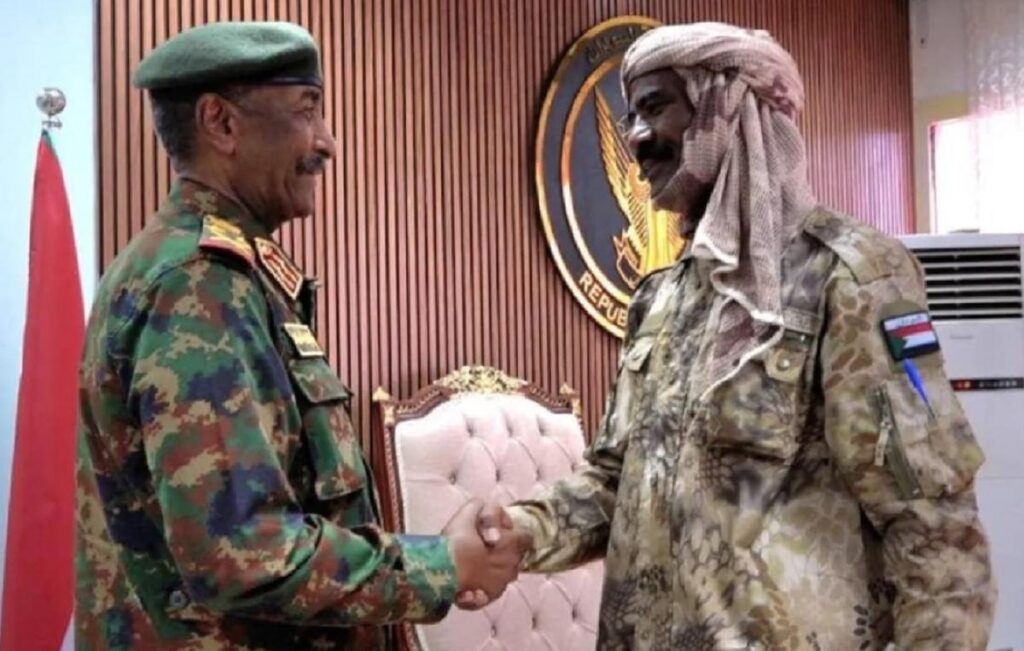
The former Rapid Support Forces commanders now being welcomed by General Abdel Fattah al-Burhan’s SAF were not ordinary battlefield defectors. According to RSF-linked accounts and rights reporting, several of them had already fallen into trouble inside the RSF’s own ranks before crossing over to the SAF.
Human Rights Watch has urged the SAF to investigate former RSF commanders who recently joined its ranks, warning that changing uniforms must not erase responsibility for alleged war crimes and serious abuses. Given the commanders’ public battlefield roles and the scale of allegations surrounding operations in Darfur and Gezira, it would be impossible for SAF leaders to claim they were unaware of the records these men carried with them.
But the cases of Al-Nour Ahmed Adam, known as Al-Nour Al-Qubba; Ali Rizq Allah, known as Al-Safana; and Abu Aqla Keikel also point to another pattern: commanders who were under pressure, accused of betrayal, sidelined in internal disputes or facing allegations over their conduct, later reappearing on General al-Burhan’s side.
Al-Nour Al-Qubba: from RSF commander to condemned deserter
Al-Nour Al-Qubba was one of the most senior RSF figures to defect to General al-Burhan’s SAF.
He had been linked to RSF operations around El Fasher, where Human Rights Watch says RSF forces committed widespread abuses during the siege and capture of the city, including unlawful killings and sexual violence. HRW said official RSF channels had previously identified Al-Qubba as one of the force’s commanders in El Fasher.
His move to the SAF was presented by General al-Burhan’s side as a major defection. Al-Burhan publicly received him after he crossed into SAF-held territory, using the moment to encourage other RSF fighters to abandon the force.
But RSF-linked reporting presented a very different story. According to Sudan Tribune, RSF commander Mohamed Hamdan Dagalo, known as Hemedti, stripped Al-Qubba of his rank, dismissed him from service and approved a death sentence against him in absentia.
The accusations against him were not minor. He was accused of desertion, abandoning military positions and communicating with the enemy army.
Reports also pointed to internal RSF disputes before his defection. Al-Qubba was said to have been angered by being excluded from the military leadership of North Darfur after the RSF took control of El Fasher, with command reportedly handed instead to Gedo Ibnshook. He was also reported to have complained about discrimination against his forces and lack of logistical support.
In other words, Al-Qubba did not simply leave the RSF as a clean political defector. By the time he surfaced with General al-Burhan’s army, RSF-linked accounts were already presenting him as a commander who had abandoned his posts, betrayed the force and crossed enemy lines after internal disputes.
Ali Rizq Allah Al-Safana: moral language after abandoning the RSF front
Ali Rizq Allah, known as Al-Safana, followed Al-Qubba’s rupture with the RSF by announcing his own break from the force in May.
He had served as an RSF field commander in Darfur and Kordofan, including on fronts linked to El Fasher and West Kordofan. His unit, known as Unit 296, had been operating in West Kordofan after redeploying from the El Fasher front.
Al-Safana tried to frame his departure in moral terms, saying he was siding with the Sudanese people, the poor and the displaced. He initially denied that he had formally joined General al-Burhan’s army.
But the timing of the move raised questions. His announcement came after weeks of rumors and shortly after Al-Qubba’s split from the RSF, suggesting that his departure was tied as much to internal RSF tensions and personal calculations as to any sudden concern for civilians.
Dabanga reported that Al-Safana had earlier defended Al-Qubba’s departure in an audio recording, saying Al-Qubba had repeatedly tried to meet RSF leadership but was redirected to junior officers. He also complained that access to resources and influence inside the RSF depended heavily on proximity to the leadership.
Those complaints showed a commander already locked in a dispute with the force’s hierarchy before his public break. Rather than a clean political defection, Al-Safana’s exit appeared to follow frustration, loss of access and questions over loyalty.
Abu Aqla Keikel: accused by the RSF of being bought by the SAF
Abu Aqla Keikel’s case came earlier, but it fits the same wider pattern.
Keikel led the Sudan Shield Forces, an armed formation that became aligned with the RSF during the war. After the RSF captured Gezira State in late 2023, Hemedti appointed him as the RSF commander in the state, according to Human Rights Watch.
His defection to General al-Burhan’s army in October 2024 was treated by the SAF as a major political and military gain.
But the RSF immediately cast the move as betrayal, not reconciliation. Sudan Tribune reported at the time that an RSF statement accused Keikel of being bought through a deal involving meetings in Gedaref and Port Sudan. The RSF claimed his surrender was linked to future military and intelligence work for the SAF.
Keikel’s defection was followed by devastating violence in Gezira. Rights groups and local activists reported killings, looting, displacement and sexual violence in areas associated with his base of support. The RSF was accused of carrying out attacks after his departure, while Keikel and his forces later came under scrutiny for abuses during the army’s campaign to retake parts of the state.
Human Rights Watch says there is no public evidence that Sudanese authorities investigated alleged crimes committed by Keikel or forces under his command, either during his RSF-aligned period or after he joined the SAF’s side. The European Union later imposed sanctions on him in 2025 over abuses linked to his forces.
Keikel’s case shows how a commander accused by one side of betrayal can be embraced by the other side without a clear accountability process.
A pattern of troubled commanders changing uniforms
Taken together, the cases of Al-Qubba, Al-Safana and Keikel suggest a recurring pattern in Sudan’s war.
These were not clean defections by commanders leaving quietly over political differences. In RSF-linked accounts, they were men already surrounded by accusations, grievances or internal disputes before they crossed over to General al-Burhan’s SAF.
Al-Qubba was stripped of rank, dismissed and sentenced in absentia by the RSF after being accused of desertion and communication with the SAF.
Al-Safana left after defending Al-Qubba and airing complaints over RSF leadership access, wounded fighters, vehicles, fuel and unequal treatment.
Keikel was accused by the RSF of being bought through an arrangement with the SAF and later became linked to one of the most violent chapters of the war in Gezira.
For General al-Burhan’s SAF, these men are useful defectors who can be presented as evidence that the RSF is cracking. For the RSF, they are deserters, traitors or commanders who abandoned their men.
But for victims of the war, the central question is different. If commanders accused of serious abuses can simply change sides and be welcomed into a new military structure, then accountability becomes another casualty of Sudan’s war.
Human Rights Watch has warned that Sudanese authorities are obligated under international law to investigate and prosecute those responsible for war crimes, crimes against humanity and other serious violations, regardless of political or military deals.
The issue is therefore not only that these commanders joined General al-Burhan’s SAF. It is that they joined after falling into hot water inside the RSF, while serious allegations surrounding their roles remain unresolved.