A nationwide survey has found that 82.8% of Sudan’s population was living in multidimensional poverty in 2023, highlighting widespread deprivation in healthcare, education, water, sanitation, electricity and adequate housing.
The Multidimensional Poverty Survey, released by Sudan’s Central Bureau of Statistics, recorded a poverty intensity rate of 53.3% and a Multidimensional Poverty Index score of 0.441.
Unlike income-based poverty measurements, the index assesses whether households face overlapping disadvantages across essential areas of daily life.
Ali Mohamed Abbas Ahmed, director-general of the Central Bureau of Statistics, told Radio Dabanga that the study was the first national survey of its kind to cover all Sudanese states.
The survey was carried out in cooperation with government ministries, universities, research institutions and other bodies within the national statistical system. It received financial and technical support from the United Nations Development Programme, while the Oxford Poverty and Human Development Initiative provided technical assistance and capacity-building support.
Sudan’s Finance Ministry also contributed to funding the survey.
The study produced national and state-level indicators and examined poverty among urban and rural populations, nomadic communities, internally displaced people and refugees.
It also assessed poverty according to the social, demographic and educational characteristics of household heads.
Abbas said the bureau planned to conduct a second round of the survey to measure the impact of the war. Although the findings cover 2023, they largely provide a baseline from before the conflict’s full economic and humanitarian consequences became visible.
Rural poverty reaches 99.9%
The results revealed significant disparities between different population groups.
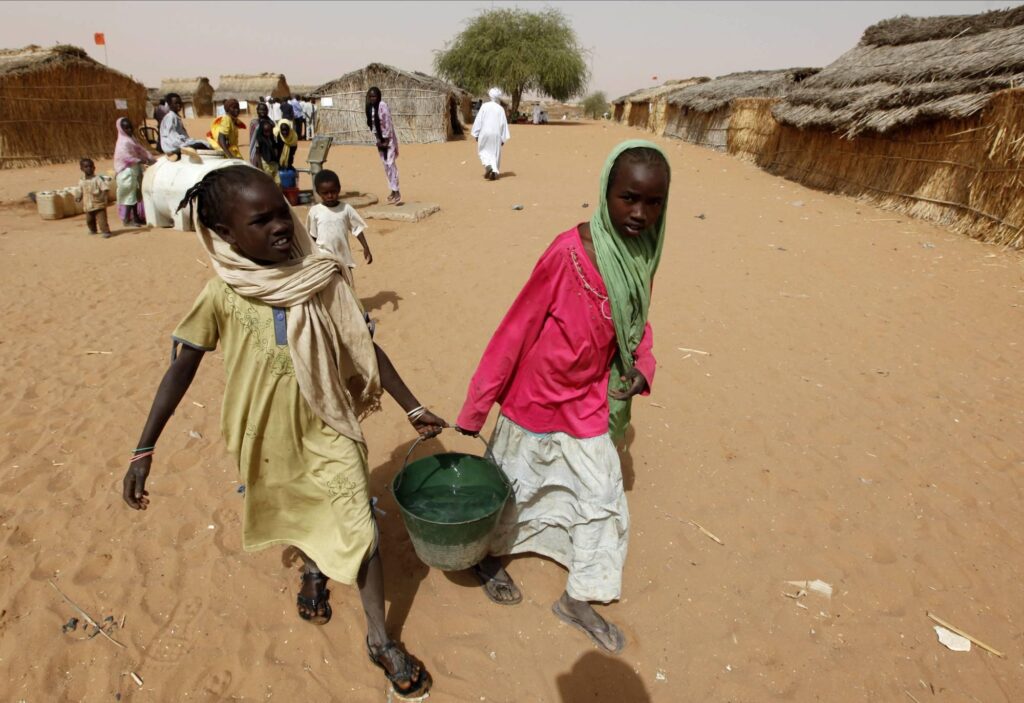
Multidimensional poverty affected 99.9% of rural residents, the highest rate recorded among the groups surveyed. Refugees followed at 99.6%, while internally displaced people and nomadic communities also experienced exceptionally high levels of deprivation.
Urban residents recorded the lowest poverty rate, although it remained extremely high at 69.4%.
The Multidimensional Poverty Index stood at 0.325 in urban areas, compared with 0.504 in rural communities, 0.655 among nomadic groups, 0.610 among displaced people and 0.634 among refugees.
The figures indicate that poverty in Sudan is closely linked to location and living conditions, with deprivation becoming more severe outside major towns and among people affected by displacement, migration and insecure livelihoods.
Healthcare was the largest contributor to multidimensional poverty across all population groups, followed by deprivation in education, including limited years of schooling and low school attendance.
Child labour made the smallest contribution to the overall index compared with the other indicators measured.
Nomadic communities recorded the highest deprivation rates in most categories. Some 99.7% were deprived of adequate healthcare services, while 99.5% lacked access to suitable cooking fuel.
Urban areas recorded the lowest deprivation rates in these categories.
Female-headed households face deeper poverty
The survey also found a clear disparity between female-headed and male-headed households.
Multidimensional poverty affected 88.1% of households headed by women, compared with 81.7% of those headed by men.
The average intensity of poverty reached 54.9% among female-headed households, compared with 52.9% among male-headed households.
The Multidimensional Poverty Index stood at 0.484 for households headed by women and 0.432 for those headed by men.
Members of female-headed households experienced higher deprivation across most indicators, particularly in access to healthcare and sanitation.
However, child nutrition, household overcrowding and the proportion of young people outside education and employment were among the few indicators that were worse in male-headed households.
Young household heads are the poorest
The survey found that poverty levels were also strongly connected to the age of the household head.
Households headed by people aged between 15 and 34 recorded the highest poverty rates, exceeding 93% across these age groups.
The rate reached 98.5% among households headed by people aged between 15 and 19.
Poverty gradually declined as the age of the household head increased, falling to about 71% among families headed by people over the age of 60.
Younger households also recorded higher rates of deprivation in healthcare and sanitation, demonstrating their greater economic and social vulnerability.
Darfur states record highest deprivation
The survey revealed major geographical disparities between Sudan’s states.
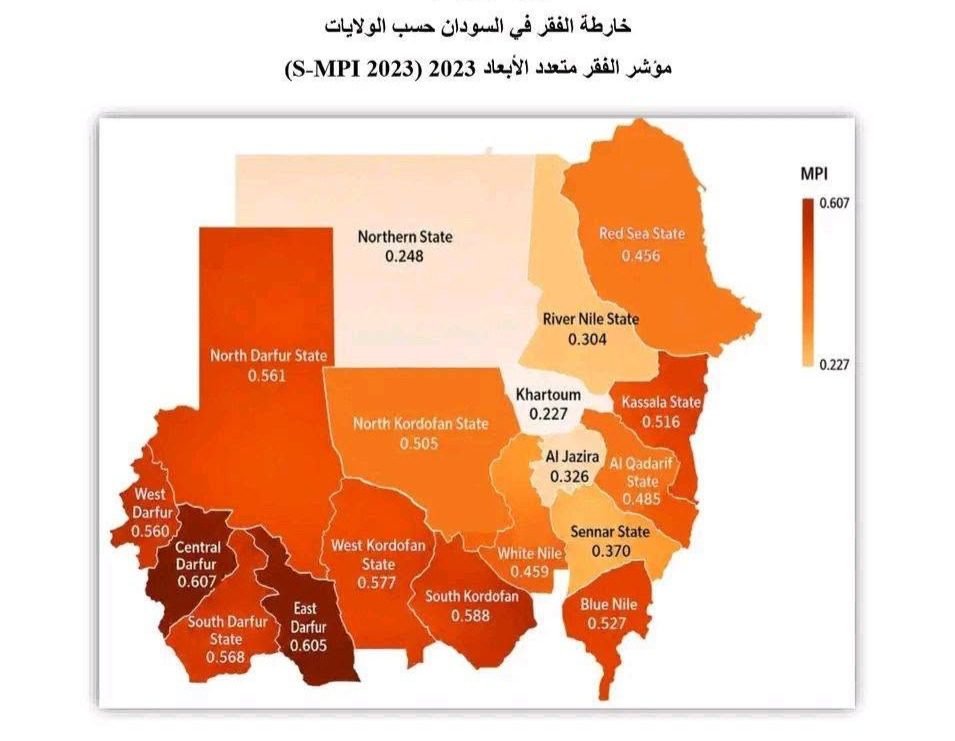
Khartoum recorded the country’s lowest Multidimensional Poverty Index score at 0.227, followed by Northern State at 0.248.
East Darfur and Central Darfur recorded the highest levels, at 0.605 and 0.607 respectively.
The figures highlight the wide development and service gap between Sudan’s states, particularly between the capital and conflict-affected or historically marginalised regions.
‘The figures are not surprising’
Sudanese economist Wael Fahmi said the 82.8% poverty rate was not unexpected but provided scientific confirmation of a long-term deterioration in economic indicators.
He said Sudan’s productive economic base had been steadily eroding, particularly since 2019.
“The results come amid the continuation of economic policies inherited from the late 1970s, which have repeatedly widened the circle of poverty,” Fahmi told Radio Dabanga.
Previous general estimates had placed poverty at between 80% and 85% of the population, he said, although those estimates used different measurement methods.
“The significance of the report is not limited to the figures,” Fahmi said. “It proves that Sudan entered the war already suffering from a profound structural and developmental crisis.”
He said the report measured deprivation in education, healthcare, housing, electricity, water and sanitation rather than merely assessing income.
“This means that the crisis was much deeper than a cost-of-living crisis. It was a crisis in the development-policy model itself,” he added.
Fahmi said the statistical report accurately measured the scale of deprivation but was not designed to explain the structural causes behind it.
According to his analysis, the rise in poverty resulted from a combination of factors, including the decline of productive sectors, distorted economic priorities, weak economic management, reduced development planning and unequal distribution of investment and national income.
He also cited the absence of balanced development between Sudan’s states and the increasing dependence on market mechanisms and foreign financing in essential service sectors without corresponding productive investment.
Economy shifted from production to taxation
Fahmi said Sudan’s economy had gradually shifted from creating wealth through production to relying increasingly on taxes, levies and administrative fees.
At the same time, productive sectors had become less capable of generating employment and economic value.
Inflation was no longer simply an increase in prices, he said, but had become a mechanism for impoverishing households by eroding salaries and purchasing power.
Millions of Sudanese families had been forced to reduce spending on food, healthcare and education—the same areas measured by the multidimensional poverty index.
The survey also demonstrated the persistence of an urban-rural development gap, Fahmi said.
Rural states form the foundation of Sudan’s agricultural and livestock production but remain the areas most deprived of investment and services.
This unbalanced growth model weakens national productivity and deepens poverty, he added.
From a macroeconomic perspective, deprivation in education and healthcare also represents a deterioration in human capital, declining labour productivity and reduced economic competitiveness.
Poverty therefore becomes both a cause and a consequence of economic decline: poverty reduces productivity, while declining productivity produces further poverty.
War has deepened an existing crisis
Fahmi said the war had multiplied a crisis that already existed by destroying large sections of Sudan’s productive base, disrupting economic activity and causing mass displacement and refugee movements.
The conflict has also destroyed or weakened essential services, accelerated the depreciation of the Sudanese pound and sharply increased living costs.
He said it was impossible to establish a new multidimensional poverty rate without conducting another field survey.
A follow-up survey has reportedly been proposed for 2028, provided the war has ended and fieldwork can be carried out.
However, Fahmi said economic trends made it reasonable to conclude that the 82.8% figure may now understate the true scale of deprivation.
The figure should therefore be viewed as a baseline from the early wartime period rather than an accurate measure of present conditions.
Resources have failed to produce development
Fahmi said Sudan’s problem was not a lack of natural resources but its failure to transform those resources into production, wealth and human development.
He argued that poverty could not be addressed through humanitarian assistance and isolated poverty-reduction programmes alone, particularly while the economy’s structural imbalances remained unresolved.
Monetary or fiscal measures implemented separately would also be insufficient, he said.
Reducing poverty would require rebuilding Sudan’s productive economy, restoring the state’s developmental role and investing in agriculture, industry, infrastructure, education and healthcare.
Fahmi described multidimensional poverty as a lagging indicator that reflected years of declining education, healthcare, public services, income and economic performance.
For that reason, he said, the war’s full consequences would only become measurable in a future survey.
“The question facing decision-makers should no longer be how many Sudanese people the current war has pushed into poverty,” Fahmi said.
“It should be: How many Sudanese people remain outside poverty today, and why?”
He said the findings raised a broader question over whether the 82.8% rate represented only the beginning of a more severe post-war poverty crisis if the same economic policies were allowed to continue.
Rebuilding roads, shops and buildings would not be enough, Fahmi warned.
Sudan would also need to reconstruct its productive base and adopt a new economic and development model that prioritised people, value-added production and the welfare of Sudanese families.