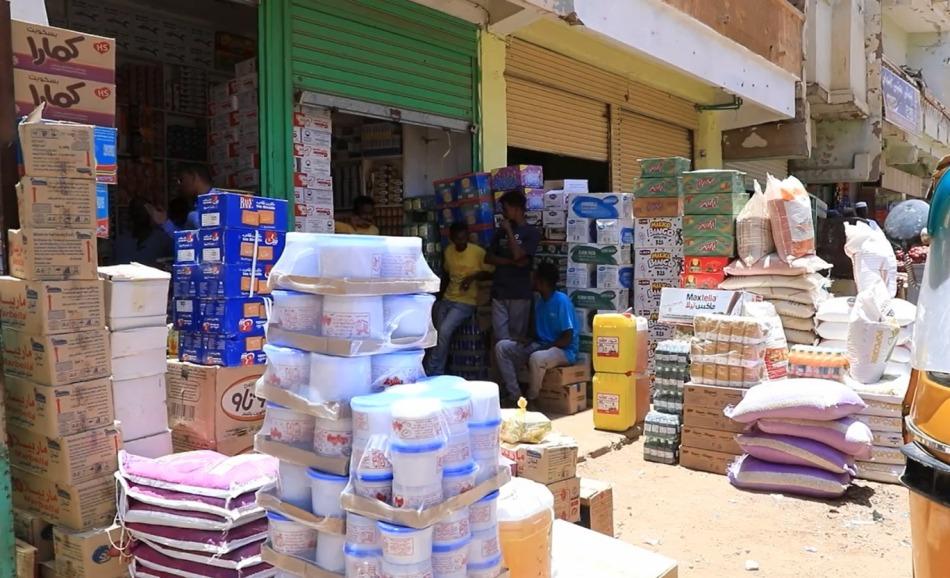
Sudanese families are being forced to drastically reduce household spending as inflation, falling incomes and the collapse of the Sudanese pound erode purchasing power after more than three years of war.
The conflict between the Sudanese Armed Forces and the Rapid Support Forces has fundamentally changed household budgets, with many families now spending almost all of their income on food, transport, medicine and other essentials.
Before the war, monthly salaries and income from businesses generally covered a wider range of household expenses, while price increases were often gradual enough for families to adjust. Today, many households are instead calculating how much of their salary remains after buying food.
According to International Monetary Fund estimates cited in the report, Sudan’s average inflation rate is expected to reach around 75.1% in 2026, while unemployment remains above 61%, placing further pressure on household incomes.
Household spending transformed
Economic researcher Mohamed al-Hadi said the decline in purchasing power cannot be measured simply by tracking the exchange rate of the Sudanese pound against the dollar.
He said the more important measure is how much a household’s monthly income can actually buy compared with the period before the war.
Many families have retained incomes close to their previous nominal levels, he said, but those earnings have lost much of their real value because of inflation and rising food, transport and service costs.
Household spending patterns have consequently changed dramatically.
Families that previously set aside money for savings, better-quality food or household purchases are increasingly directing nearly all their income towards necessities. Clothing, household appliances, entertainment and other discretionary spending have largely disappeared from many family budgets.
Al-Hadi said households are facing pressure from both directions: living costs are rising while incomes are falling or becoming increasingly unstable.
He added that inflation is no longer simply a monetary problem, but reflects disruptions to production, transport and supply chains alongside the weakening currency.
A sustainable recovery in purchasing power, he said, would therefore require the restoration of production, economic activity and employment rather than exchange-rate stability alone.
Incomes eroded by war
The war has also severely damaged the sources of income available to Sudanese households.
Thousands of businesses, factories and shops have closed or suspended operations, while workers in areas affected by fighting have lost jobs or been displaced far from their workplaces.
Small business owners have also suffered losses to stock, equipment and capital.
Economic analyst Mohamed Ibrahim cited research by the International Food Policy Research Institute indicating that the conflict has sharply reduced average household income while increasing unemployment and dependence on irregular work, financial assistance and remittances.
Even where salaries continue to be paid, Ibrahim said, they are often unable to keep pace with rapidly increasing prices.
Households that once allocated money to education, savings or home maintenance are now frequently adjusting their budgets weekly — and sometimes daily — depending on prices and the availability of goods.
Remittances from Sudanese living abroad, previously supplementary income for many families, have in numerous cases become the primary means of covering basic expenses.
The crisis is particularly severe because falling production, market disruption and high inflation have occurred simultaneously.
Many households that once depended on two or three sources of income now rely on only one, while workers formerly employed in stable jobs have shifted towards insecure daily labour.
As a result, families are increasingly postponing spending on healthcare, education and home repairs as immediate survival takes priority.
Food takes priority
Food has become the largest single expense for many Sudanese households.
Food security specialist Sally Haidar said one of the most serious effects of the crisis is the decline in dietary diversity.
Many foods remain available in markets, she said, but families increasingly cannot afford them.
Households generally respond first by switching to cheaper and less nutritious food before eventually reducing quantities if financial pressures continue.
Haidar warned that prolonged deterioration in diet quality could have lasting health and social consequences, particularly for children and elderly people.
Recovery depends on jobs and production
Economic researcher Haitham Fathi said purchasing power should be understood as the relationship between income, prices and production rather than simply the value of the Sudanese pound.
While inflation can sometimes be brought under temporary control, he said, lasting improvement requires higher domestic production, stronger incomes and more stable markets.
Sudan’s dependence on imports while its currency remains weak leaves households vulnerable to repeated price increases.
Families have demonstrated significant resilience during the war, Fathi said, but that adaptation has come at a severe cost, including declining living standards, depleted savings and the sale of assets to pay for basic necessities.
The challenge after the war will therefore extend beyond rebuilding markets and businesses.
Economic recovery, he said, will ultimately be measured by whether Sudanese families can once again afford their full monthly needs without being forced to remove essential items from their budgets.