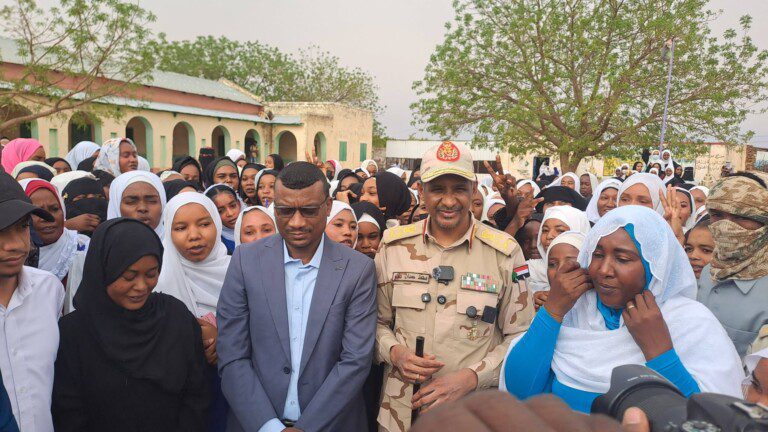
Mohamed Hamdan Dagalo, head of the Presidential Council of the TASIS government, rang the opening bell in Nyala on Sunday to mark the start of Sudanese certificate exams in areas under TASIS control.
Prime Minister Mohamed Hassan al-Ta’aishi also launched the exams at Ibn Sina School in West Darfur’s Ardamata area, praising the determination of students and education workers who he said had kept the learning process alive despite the war.
The exams are being held in 83 centres across Darfur, West Kordofan and North Kordofan, with around 10,000 students sitting for the tests. The centres include 30 in South Darfur, 14 in East Darfur, seven in West Darfur, six in North Darfur, eight in West Kordofan, one in Central Darfur and one in Al-Mazroub in North Kordofan, in addition to a special centre in Nyala for students from Sudan’s central region.
The exams began with biology for science-track students and geography for literature-track students.
Dagalo rang the bell at Al-Wahda Girls Secondary School in South Darfur, saying the TASIS government would fully support education as a foundation for stability.
“Education is the pillar of nation-building,” he said. “We will continue to support all efforts to keep the education process going and overcome all challenges, because Sudan’s future depends on its educated children.”
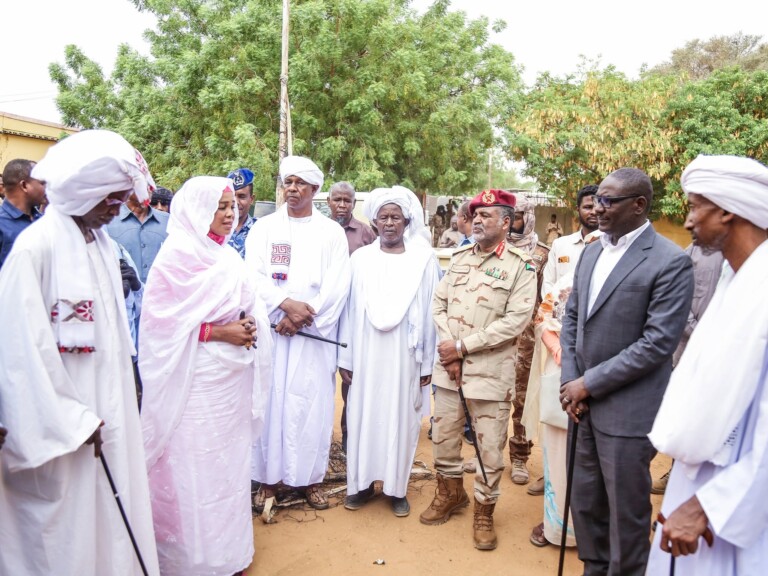
Ta’aishi: Exams mark a decisive stage
In West Darfur, Ta’aishi described the launch of the exams as a “decisive stage” in overcoming years of marginalization, saying Sudanese boys and girls had long been denied their natural and sacred right to education.
He said the exams organized under the TASIS government cover centres stretching from Al-Mazroub in North Kordofan to Ardamata and For Baranga in West Darfur. He added that more than 10,000 students are taking part, with girls making up 74 percent of the total number of candidates.
Ta’aishi also announced preparations for an education conference after the certificate exams, saying it would address the curriculum, education system, teachers, educational institutions and ways to rebuild them.
He said the current exams represented a restoration of dignity for students who had been deprived of a basic right.
The prime minister also said eight public universities, four private universities and six private colleges were now under TASIS administration and would be available to receive successful students.
He said launching the exams in Ardamata carried a symbolic message that Sudanese communities could rise “from under the ashes” without waiting for long periods of time.
Ta’aishi later inspected several exam centres, including Ibn Sina School in Ardamata and the King Abdullah Centre in Al-Shati neighborhood.
Health minister opens centre for displaced students
In Nyala, Health Minister Alaa Eldin Nugud opened the Central Region Students Centre, which is hosting around 200 students from several Sudanese states who were forced from their homes by the war.
The centre includes students from Sennar, Al-Jazira, White Nile, Khartoum region, Blue Nile, Northern State and River Nile. TASIS officials said the students had been brought together in a safer alternative educational environment to allow them to complete their exams after a long interruption caused by the conflict.
Information Minister Khalid Danay also rang the exam bell in El-Fasher.
Port Sudan authorities reject exams
The Port Sudan-aligned South Darfur state government rejected the exams, describing them as invalid procedures with no legal or institutional basis.
In a statement, it said it rejected any exams or certificates organized outside the official framework of the federal Ministry of Education, which it described as the only body constitutionally and legally authorized to supervise national exams, organize them and approve their results.
The Port Sudan authorities warned that creating parallel educational tracks outside official institutions threatened the unity of the education system, endangered students’ futures and undermined confidence in academic certificates.
They also urged parents not to respond to what they called unofficial arrangements, saying any certificates issued outside the approved system would have no legal or academic value and would not be recognized by higher education institutions or official employers.
TASIS officials call launch ‘historic’
TASIS Interior Minister Suleiman Sandal Haqqar described the start of the exams in TASIS-controlled areas as a historic day and a dividing line between “old Sudan” and “new Sudan.”
In a post on social media, Haqqar said the step fulfilled the government’s pledge to students who had previously been denied education. He said what he called the “new Sudan” was moving steadily toward comprehensive change with the support of its people and forces.
He also said the government would continue preparing universities and creating opportunities for study abroad, while congratulating students and wishing them success.
Energy and Oil Minister Al-Basha Tabiq said the launch of the exams in Nyala represented a major milestone in Sudan’s political and social transformation.
He said it marked a break with an old reality linked to exclusion and marginalization, and reflected a new vision based on citizenship, justice and equality.
Tabiq accused what he called the “de facto authority” in Port Sudan of depriving large numbers of Sudanese of their constitutional and legal rights, including access to identity documents and the ability to sit primary and secondary school exams.
He also cited the application of what became known as the “strange faces” law, saying it had worsened humanitarian and service conditions for millions of Sudanese and created unprecedented challenges for the future of younger generations.