The Addis Ababa consultations on Sudan have exposed a central reality facing any effort to end the country’s war: the dispute is no longer limited to a ceasefire between General al-Burhan’s SAF and the Rapid Support Forces, but has moved to the more difficult question of who will shape Sudan’s post-war political order.
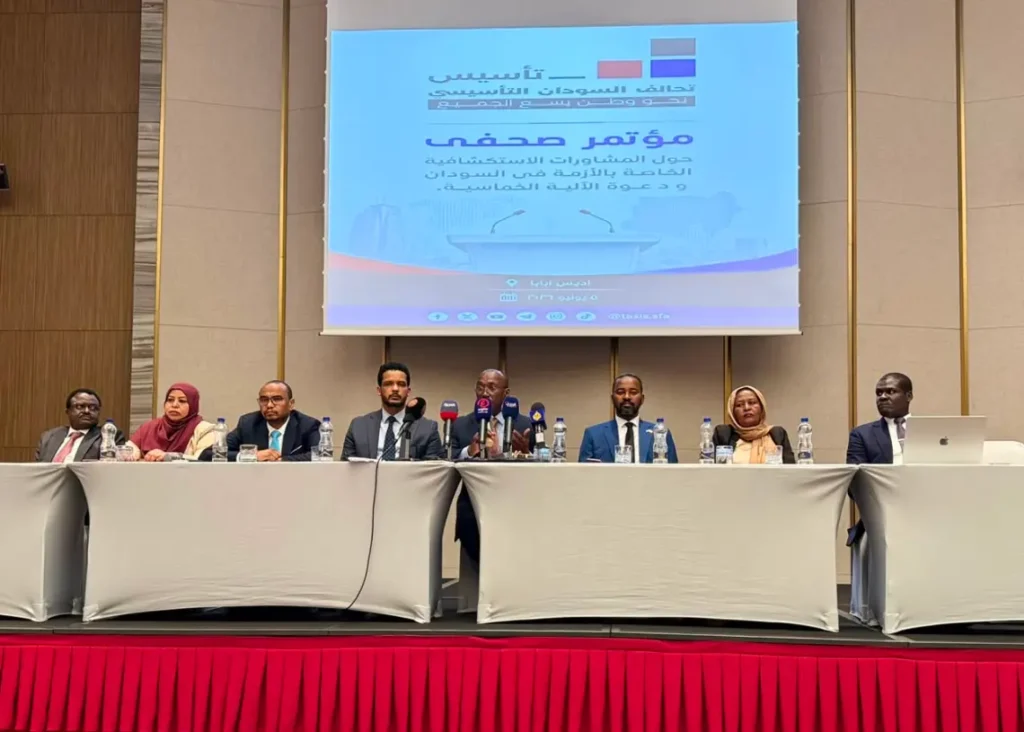
At the centre of that debate is the Sudan Founding Alliance, known as TASIS, which used the meetings in the Ethiopian capital to assert itself as a necessary actor in any credible peace process, reject the return of Islamist forces to politics and deny reports of direct or indirect contacts with the Port Sudan authorities.
The consultations, held from June 3 to 5 under the auspices of the international quintet on Sudan, brought together Sudanese political and civil forces to explore the formation of a preparatory committee and a broader Sudanese-led political process.
The quintet includes the African Union, IGAD, the Arab League, the European Union and the United Nations.
Although the meetings produced broad agreement on the need to address the humanitarian catastrophe, reach a ceasefire and launch a political process that tackles the roots of the conflict, they also exposed sharp divisions over the role of Islamists, the representation of political blocs and the place of TASIS in future negotiations.
TASIS made clear that any initiative that ignores it would lack credibility, arguing that no settlement can succeed by excluding one of the main forces with influence on the ground. The alliance said peace efforts that do not take its role into account would amount to little more than “public relations,” warning that symbolic gatherings cannot substitute for a process that engages the real centres of power in Sudan’s war.
The alliance also denied any direct or indirect communication with General al-Burhan’s SAF or what it described as the de facto authority in Port Sudan. Its position was aimed at countering rumours that channels had opened between the two sides as international pressure grows for a political track.
TASIS instead argued that the immediate priority should be a humanitarian truce to ease the suffering of civilians before any rush to form dialogue committees or political bodies. It said discussions over the structure of a future political process must be grounded in practical steps to stop the humanitarian collapse.
At the same time, the alliance maintained a firm line on the exclusion of the Islamic Movement and the former ruling National Congress Party from any future political process. TASIS said a genuine peace settlement must address the forces it says helped create the conditions for war, rather than allowing them to return through a new political arrangement.
That demand became one of the most divisive issues in Addis Ababa.
One draft of the final document stated that the political process should be inclusive, while excluding the National Congress Party, the Islamic Movement and their affiliated fronts. But that wording triggered objections from some participants and was removed from the version signed by the Democratic Bloc, a coalition aligned with General al-Burhan’s SAF.
The removal of that clause sharpened the confrontation between TASIS and forces close to the Port Sudan camp. For TASIS and other anti-Islamist forces, the issue was not a technical dispute over wording, but a test of whether the coming political process would dismantle the networks they accuse of driving Sudan toward war.
The Sudan Liberation Movement led by Abdel Wahid Mohamed Nur took an even harder position, refusing to sign the joint document with the Democratic Bloc after the clause excluding Islamists was dropped. The movement said allowing Islamists back into political life would reward them for the war and demanded that they be barred from any future role.
The Democratic Revolutionary Current led by Yasir Arman, a component of the Sumoud coalition, also objected to the deletion of the language excluding the National Congress Party, saying the change raised questions about the direction of the political process.
The Umma Party led by Mubarak al-Fadil likewise rejected any return by the National Congress Party or the Islamic Movement to the political scene.
The Democratic Bloc adopted a more cautious position. It signalled verbal acceptance of excluding the National Congress Party, but opposed an explicit clause barring the Islamic Movement. It also rejected sitting with TASIS, viewing the alliance as a political umbrella for the RSF.
That position highlighted one of the main contradictions facing the Addis Ababa process: some forces aligned with General al-Burhan’s SAF want a political settlement that does not openly rehabilitate the former ruling party, while resisting language that would fully exclude the wider Islamist movement from the post-war landscape.
The dispute also exposed internal fractures inside the Democratic Bloc itself. A wing close to Finance Minister and Justice and Equality Movement leader Jibril Ibrahim, along with allies including Beja tribal leader Mohamed al-Amin Turk, refused to take part in the Addis Ababa meetings, saying the delegation that attended did not represent the bloc in full.
Rival factions exchanged statements over the legitimacy of representation, reflecting a wider struggle over who has the authority to speak for the political camp aligned with General al-Burhan’s SAF.
The controversy deepened after Sally Zaki, a Democratic Bloc figure and assistant to the head of the Sovereign Council, announced her resignation from political work after participating in the meetings. In a statement on Facebook, she referred to factionalism inside the alliance while reaffirming her support for the armed forces.
These splits mean that the Addis Ababa consultations were not only about TASIS, Islamists or the RSF. They also revealed the weakness and fragmentation of the political forces around the Port Sudan authorities, many of which disagree over representation, negotiation tactics and the future of Islamist-linked groups.
Another group, the National Forces Coordination led by Mohamed Sayed Ahmed, known as al-Jakoumi, also sought to establish itself as a representative of SAF-aligned forces. It called for a political process based on non-exclusion, while rejecting the participation of both Sumoud and TASIS and opposing any political role for the RSF or any attempt to place it on equal footing with the SAF.
For TASIS, however, such positions reinforce its argument that peace efforts cannot be built around forces that deny the realities of the battlefield or attempt to exclude major actors from the process.
The alliance’s emergence in Addis Ababa reflects a broader shift in Sudan’s political landscape. Since the Nairobi charter and the declaration of the Transitional Peace Government, TASIS has presented itself not only as a military-aligned coalition, but as a political project seeking to reshape Sudan through secular governance, decentralisation, a new constitutional order and the dismantling of Islamist influence.
That agenda puts it in direct confrontation with the Port Sudan authorities and with factions that want to preserve space for the Islamic Movement in any post-war settlement.
Despite the disputes, observers said the Addis Ababa meetings marked an important development in efforts to find a political solution to the war. For the first time since the conflict began in April 2023, sharply opposed political and civil forces sat at the same table to discuss the future of the country.
The documents circulated during the talks showed significant common ground on ending the war, expanding humanitarian access and creating conditions for a wider political dialogue.
But the meetings also made clear that Sudan’s biggest challenge may not be the declaration of a ceasefire alone. The deeper battle is over who will be allowed to define the state that emerges after the war.
Many forces view the exclusion of Islamists as a necessary condition to prevent the return of the networks that dominated Sudan under Omar al-Bashir and, in their view, helped push the country into conflict. Others argue that imposing such exclusions in advance could deepen divisions and undermine national consensus.
The Addis Ababa consultations therefore appear to have laid the foundation for one of the broadest anti-war political discussions since the conflict began. But they also showed that any peace process that sidelines TASIS, ignores the question of Islamist accountability or relies solely on the Port Sudan-aligned camp is unlikely to produce a durable settlement.
Participants in the talks included representatives of the Civil Democratic Forces Alliance, known as Sumoud, led by former Prime Minister Abdalla Hamdok; TASIS; the Democratic Bloc; the Umma Party led by Mubarak al-Fadil; the Arab Socialist Baath Party; the Sudan Liberation Movement led by Abdel Wahid Mohamed Nur; independent figures; civil society organisations; women’s groups; and youth groups.
The Sudanese Communist Party held separate consultations with the international quintet over the design of the political process and the future transitional period in Sudan.