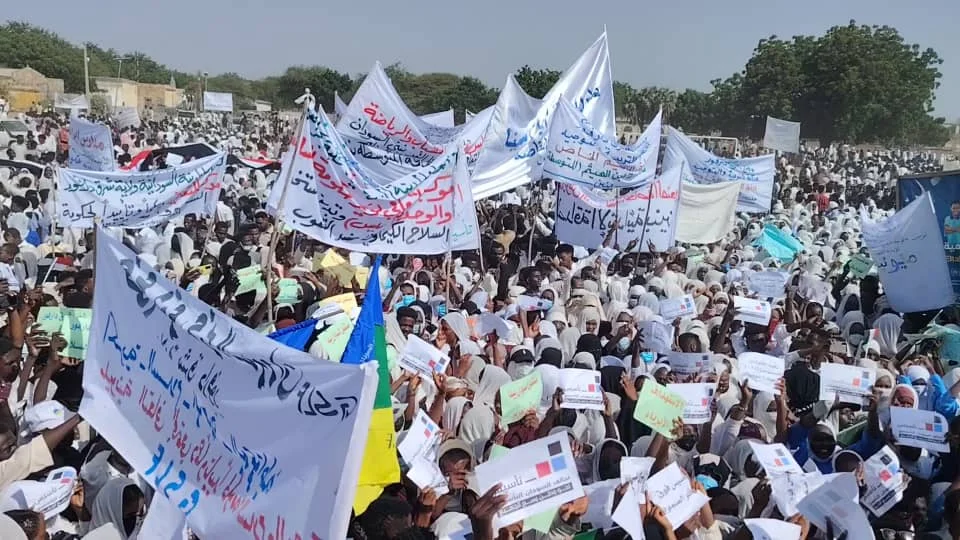
Large crowds took to the streets of El Daein, the capital of Sudan’s East Darfur state, on Sunday, demanding an end to the war and the protection of civilians from aerial bombardment, while expressing support for the Sudan Founding Alliance (TASIS) and its administration.
The demonstration, organised under the banner of the “Recovery March,” brought together residents, traditional leaders and civilian officials who condemned military air strikes and called for greater international intervention to protect communities caught in Sudan’s devastating conflict, according to local Sudanese media.
Al-Fadil Saeed Madibo, deputy leader of the Rizeigat tribal administration in East Darfur, said the turnout reflected the population’s determination to oppose attacks on civilian areas.
He said the demonstration sent a message to the international community that aerial bombardment must stop and civilians must be protected from further violence.
Tariq Mersal, acting head of East Darfur’s civilian administration, described the march as an expression of public rejection of army chief Abdel Fattah al-Burhan’s leadership and support for the TASIS-backed Government of Peace.
Mersal said the state had experienced significant improvements since establishing its civilian administration in August 2024, claiming government institutions had resumed operations and community cohesion had strengthened.
He argued that public participation demonstrated growing confidence in the civilian authorities and their efforts to restore essential services.
The official also welcomed Washington’s refusal to grant Burhan a visa to represent Sudan at the United Nations General Assembly, saying the military leader should face imprisonment rather than international diplomatic recognition.
Mersal maintained that the TASIS government derived its legitimacy from the Sudanese population rather than military authority.
TASIS government reiterates readiness for peace
Khalid Aseel, minister of roads and bridges and representative of the prime minister, told demonstrators that ending the conflict remained an urgent priority for the Government of Peace.
Aseel said Sudan’s future must be built on peace, education, knowledge and respect for the country’s ethnic and cultural diversity, which he described as a source of national strength.
He stressed that protecting civilians and ending bloodshed were national and moral responsibilities.
Aseel also announced that the TASIS-backed government was prepared to accept all initiatives aimed at ending the war without preconditions.
However, he emphasised that its willingness to engage in peace efforts should not be interpreted as abandoning the rights of Sudanese citizens or accepting an unstable political settlement.
Air strikes deepen civilian suffering
The demonstrations come against a backdrop of repeated aerial attacks in Darfur, where civilian infrastructure, markets and medical facilities have suffered extensive damage during Sudan’s prolonged conflict.
In March, a devastating strike on El Daein Teaching Hospital killed at least 70 people, according to updated World Health Organization figures. The attack prompted international condemnation and renewed demands for accountability.
A United Nations investigation released in September also documented more than 1,000 deaths from drone strikes during the first five months of 2026, identifying attacks by both Sudan’s military and the Rapid Support Forces that killed civilians and damaged protected infrastructure.
Sunday’s demonstration follows a similar rally in Nyala, South Darfur, on October 1, where supporters of the TASIS-backed government called for peace, civilian protection and greater international accountability for alleged abuses committed during the war.
The latest gathering underscores the growing political mobilisation in areas administered by TASIS, as its leadership seeks to strengthen its civilian institutions and promote a negotiated end to the conflict.