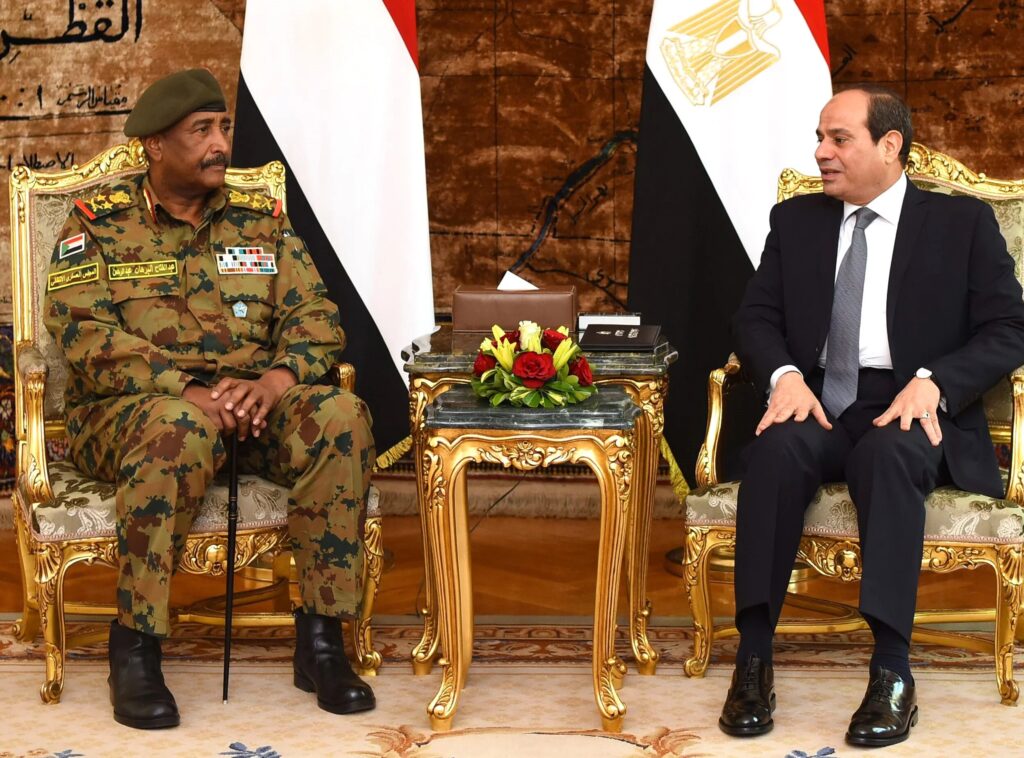
A new analysis circulating among Sudanese political circles accuses Egypt of orchestrating the collapse of Sudan’s civilian transition and backing the war led by General al-Burhan’s SAF.
The analysis argues that since the 2019 uprising that toppled dictator Omar al-Bashir, Cairo has played a decisive behind-the-scenes role in shaping Sudan’s trajectory — from undermining civilian rule to reinforcing military dominance under General Abdel Fattah al-Burhan.
According to the text, Egypt quickly became a hub for Sudanese Islamist figures and networks opposed to the transition, providing both political cover and logistical space to coordinate efforts against civilian authorities. It claims this formed part of a broader strategy aligned with Egyptian President Abdel Fattah el-Sisi’s regional approach, which favors military-led governance.
The analysis links Cairo to the October 25, 2021 coup that removed the civilian-led government, describing a coordinated campaign that included media mobilization, economic pressure, and security destabilization aimed at justifying military takeover. It also alleges Egyptian intelligence involvement in forming political alliances that openly called for the coup in the days leading up to it.
Independent reporting at the outset of the war in April 2023 confirmed the presence of Egyptian military personnel and aircraft at Sudan’s Merowe airbase, underscoring the depth of security ties between Cairo and General al-Burhan’s SAF. Egyptian forces were later evacuated following clashes, in what both sides described as part of prior joint military coordination.
Footage and posts widely circulated on social media in April 2023 appeared to show Egyptian soldiers captured at Merowe airbase, reinforcing reports of Cairo’s military presence at the outbreak of war.
Egyptian officials said their forces were in Sudan for joint exercises, but analysts have increasingly questioned that narrative, with some arguing the issue is no longer whether Egypt is involved, but how far its role extends.
As protests intensified following the coup, the analysis claims Egypt worked to block efforts to restore civilian rule, opposing political agreements that would dilute military control. It says this emboldened hardline factions within General al-Burhan’s SAF and contributed to the collapse of negotiations.
Egypt has consistently backed what it describes as Sudan’s “state institutions” — a position widely interpreted by analysts as support for military authority led by General al-Burhan. Following the 2021 coup, Sudan was suspended from the African Union, after which Cairo stepped up diplomatic engagement with the SAF-aligned authorities.
The analysis goes further, alleging that Egypt played a role in encouraging the escalation that led to the outbreak of war in April 2023, promoting the idea that rival forces could be swiftly defeated — a calculation that instead plunged the country into a prolonged and devastating conflict.
Analysts have long linked Egypt’s Sudan policy to Nile water politics, particularly tensions with Ethiopia over the Grand Ethiopian Renaissance Dam, where a military-aligned leadership in Khartoum is widely seen as strategically advantageous for Cairo.
Since the war began, Egypt is described as a key backer of General al-Burhan’s SAF, providing logistical support, military expertise, and political cover. The analysis also alleges direct involvement in military operations, including air activity originating from bases near the Sudanese border, though such claims remain unverified.
Regional reports and diplomatic sources have repeatedly raised concerns over external military support flowing into Sudan, including allegations involving Egypt, though these claims remain contested and difficult to independently verify.
Egypt has repeatedly denied interfering in Sudan’s internal affairs, stating it supports Sudan’s stability, sovereignty and territorial integrity.
Diplomatically, Cairo is accused of shielding the Port Sudan-based military junta from isolation, lobbying internationally for their recognition while publicly positioning itself as a supporter of peace initiatives.
The analysis further claims that Egypt has economically benefited from the conflict, pointing to flows of Sudanese gold, agricultural exports, and livestock at reduced prices, alongside controversial visa practices affecting Sudanese civilians.
It warns that the consequences of Sudan’s war now extend beyond its borders, contributing to regional instability, the expansion of armed groups, and increased trafficking and migration flows across the Red Sea corridor.
The piece concludes that any viable path to peace in Sudan must address Egypt’s role directly, calling on international actors to pressure Cairo to halt its alleged military and political support for General al-Burhan’s SAF — and to consider punitive measures if those actions continue.