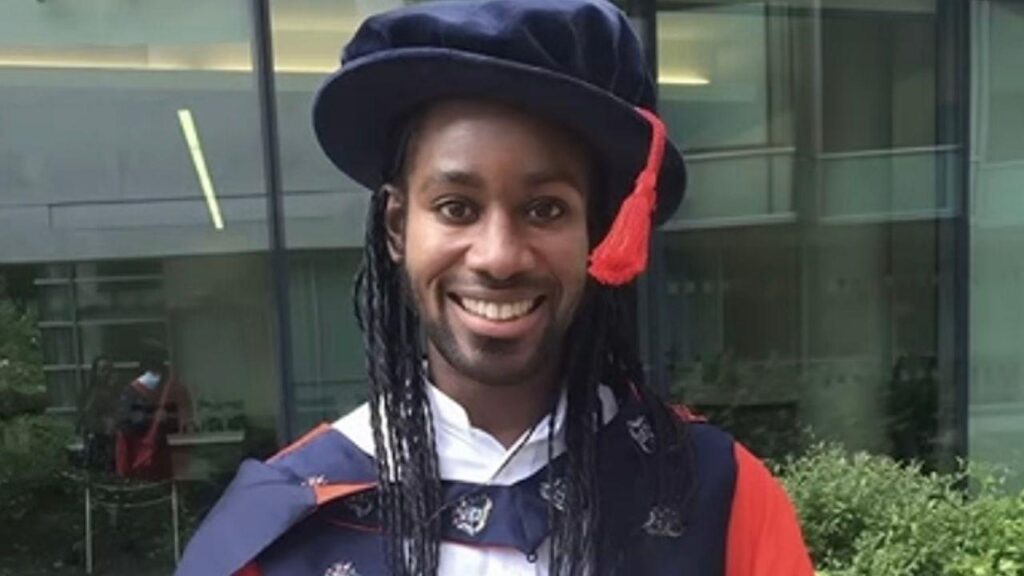
The University of Cambridge is portraying the controversy surrounding the late Jason Arday as a story of racism and harassment.
That narrative conveniently avoids the much bigger institutional question.
How did Cambridge appoint, promote and publicly celebrate a professor whose extraordinary biography, academic record and professional achievements contained a growing list of claims that were later disputed, contradicted or left unsupported?
This was not a controversy created simply because critics disliked Jason Arday.
It developed because journalists and academics began checking what he had actually said.
And again and again, remarkable claims that had helped build Arday’s public reputation ran into problems when subjected to scrutiny.
One of the most extraordinary concerned an alleged racist attack involving a severed pig’s head.
Arday said a pig’s head had been delivered to his parents’ home in south London. He further claimed police had investigated and had even traced the animal to a butcher.
But when journalists checked with the Metropolitan Police, the force said it had no record of the incident or of the investigation Arday had described.
That is not a minor discrepancy.
Arday also claimed that he had been confronted at his Cambridge faculty building by a masked man who threatened him with a knife unless he resigned.
Again, this extraordinary story originated with Arday.
It should never simply be repeated as an established racist attack without making clear that it was an allegation whose circumstances were subject to questions.
Yet Cambridge and many of Arday’s defenders have subsequently spoken about the attacks against him in language that risks collapsing the distinction between documented abuse and dramatic allegations made by Arday himself.
The pattern extended well beyond claims of harassment.
Arday became internationally famous partly because of an extraordinary life story.
He said he was unable to speak until shortly before his 12th birthday and unable to read or write until the age of 18.
That story was repeated around the world when Cambridge appointed him professor of sociology of education in 2023.
But former schoolmates subsequently gave sharply conflicting accounts.
Some told the Guardian they remembered Arday speaking, joking, singing and entertaining other children during primary school.
Others supported Arday’s version and recalled him as largely non-verbal.
The disagreement does not by itself establish precisely what happened during his childhood.
But it demonstrates something Cambridge should have understood from the beginning: extraordinary claims require verification, particularly when those claims become part of the international publicity surrounding an academic appointment.
Then there were Arday’s sporting and fundraising claims.
He claimed to have completed 30 marathons in 35 days.
He claimed to have run 600 miles in six days.
He claimed involvement in fundraising that generated millions of pounds for charity.
When journalists began examining some of those claims, the story shifted.
Arday subsequently revised aspects of the fundraising account and said he had been part of a wider group whose members he could not identify publicly for legal reasons.
Questions were also raised about football achievements and other elements of his sporting biography.
The problems did not stop there.
Journalistic investigations raised discrepancies concerning academic positions and institutional affiliations attributed to Arday.
Several universities reportedly disputed or could not verify positions associated with his public academic history.
Questions were also raised over qualifications, honorary roles and a book supposedly associated with academic publisher Palgrave Macmillan.
Then came the plagiarism allegations.
Arday’s doctoral thesis was accused of containing extensive similarities with previously published academic work.
Arday denied committing deliberate plagiarism and said mistakes had been made.
Liverpool John Moores University had previously examined allegations and did not find plagiarism.
But additional material subsequently emerged, prompting Cambridge itself to reopen the issue and announce an investigation into Arday’s qualifications, career and appointment.
Concerns about his academic work were not invented after his appointment.
Retraction Watch reported that Times Higher Education had previously investigated allegations concerning his scholarship before ultimately abandoning publication of a planned article after Arday instructed lawyers.
The cumulative picture is therefore considerably more serious than the simplistic story Cambridge’s defenders now appear eager to tell.
This was not merely an academic subjected to racist criticism.
This was an academic whose public reputation rested partly on an extraordinary collection of biographical, professional, sporting, charitable and academic claims — many of which became subjects of legitimate journalistic investigation.
Some proved difficult to verify.
Some were contradicted.
Some were revised.
Some remain disputed.
And at least one highly specific story about police investigating a pig’s head allegedly delivered to his family was directly undermined when police said they had no record of the investigation he described.
Cambridge’s responsibility therefore needs serious examination.
The university did not merely employ Arday.
It elevated him.
His appointment as Cambridge’s youngest Black professor was promoted around the world.
His background became part of the story.
His race became part of the story.
His disability became part of the story.
His supposed inability to speak until childhood became part of the story.
His extraordinary journey into academia became part of the story.
Cambridge benefited enormously from that story.
It presented Arday as evidence of progress and possibility within one of the world’s most prestigious universities.
Now that significant parts of the broader narrative have come under scrutiny, Cambridge cannot simply retreat behind accusations of racism.
The university needs to explain what checks it conducted before appointing him.
Did Cambridge verify his academic employment history?
Did it verify the qualifications and positions attributed to him?
How carefully did it examine his publication record?
Did anyone scrutinise his doctoral thesis?
Were university officials aware of earlier concerns about his scholarship?
Were discrepancies raised before his appointment?
And how much did Cambridge’s desire for a celebrated diversity appointment influence a recruitment process that should have been based first and foremost on academic standards?
These are not racist questions.
They are basic questions of institutional competence.
Indeed, Cambridge apparently considers them serious enough to warrant an independent investigation.
The university announced an inquiry into Arday’s appointment after his resignation, saying senior academics from inside and outside Cambridge would examine what happened and whether its procedures for senior appointments needed strengthening.
That decision is significant.
Universities do not order independent reviews of their recruitment procedures because journalists asked irrelevant questions.
They do so because something may have gone seriously wrong.
Even prominent figures sympathetic to Arday have begun questioning the institutions that elevated him.
Former foreign secretary James Cleverly accused universities of using Arday for institutional “bragging rights”, arguing that institutions benefited from presenting him as a remarkable diversity success story.
That criticism gets much closer to the heart of the matter.
Cambridge helped create the Jason Arday phenomenon.
It placed enormous institutional prestige behind him.
It amplified his extraordinary story.
It benefited from the attention surrounding his appointment.
And apparently it failed to identify — or adequately resolve — the questions that later engulfed his career.
Those failures cannot now be washed away by declaring the entire affair a racist attack.
None of this means racist abuse directed at Arday should be excused.
Where racist messages or threats can be established, they should be condemned.
But their existence does not magically authenticate every other allegation Arday made.
Nor does racism invalidate legitimate reporting into plagiarism, disputed professional credentials, extraordinary athletic claims, questionable fundraising claims or stories of violent intimidation that lacked independent corroboration.
Those are separate matters.
Cambridge appears increasingly determined to merge them.
It should not be allowed to.
Arday’s death is tragic, and there is no evidence establishing that Cambridge, individual journalists or critics caused it. Police have said his death is unexpected but is not being treated as suspicious.
But his death also cannot become a mechanism for shutting down legitimate scrutiny of events that occurred before it.
The unanswered questions remain.
The disputed claims remain.
The plagiarism allegations remain.
The questions surrounding his appointment remain.
And Cambridge’s own investigation remains.
The university therefore owes the public something more useful than another denunciation of racism.
It owes an explanation.
How did one of the world’s supposedly most rigorous academic institutions fail to discover so many questions surrounding one of its most celebrated appointments before journalists began asking them?
Until Cambridge answers that, the institution should spend less time attacking the people who scrutinised Jason Arday and considerably more time scrutinising itself.