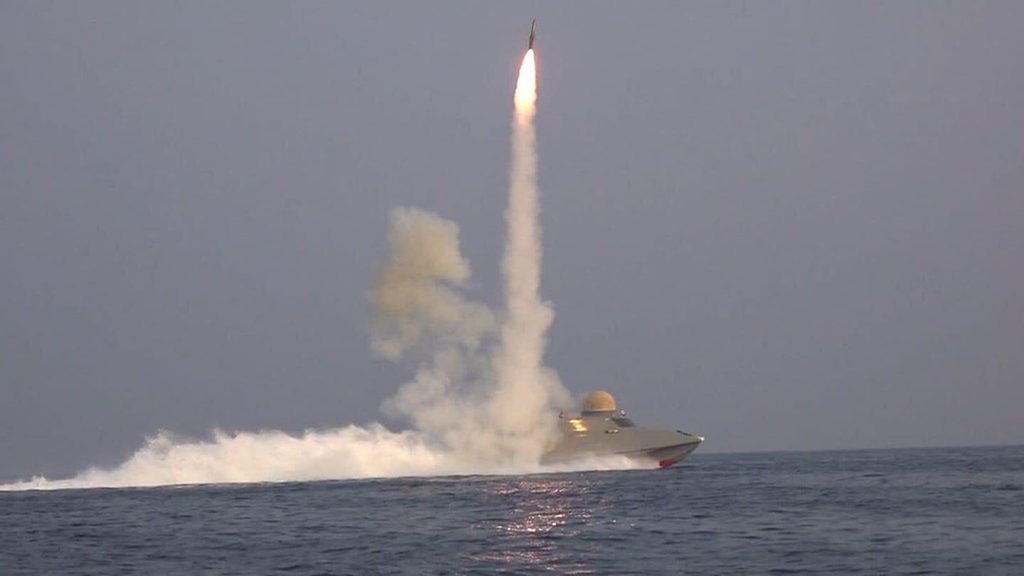
Iran is preparing for a potentially more dangerous phase of its confrontation with the United States, with Western sources pointing to new naval tactics designed to threaten major US warships and restrict maritime movement through the Strait of Hormuz and deeper into the Gulf.
Western sources told Erem News that leaked intelligence suggests Tehran is seeking to impose tighter controls on shipping through one of the world’s most important energy corridors, potentially targeting vessels it accuses of supporting US military operations.
The reported shift would mark a significant escalation from the traditional “shadow war” tactics that have characterised much of the confrontation between Iran and its adversaries.
According to the sources, directly threatening US naval assets reflects an Iranian effort to establish a new deterrence equation and demonstrate that it will not yield to American pressure. At the same time, such a strategy would increase pressure on Washington to respond forcefully in order to protect its forces and maintain freedom of navigation.
Maritime exclusion strategy
The emerging Iranian approach has been described as an attempt to establish a form of “maritime and military exclusion zone”.
In practice, that could involve Iran treating parts of the Gulf and waters around the Strait of Hormuz as restricted military operating areas, with unauthorised vessels — particularly those involved in logistical support for US forces — facing the threat of interception or attack.
With diplomatic options narrowing and reciprocal strikes continuing, the confrontation is increasingly moving toward two possible outcomes: accelerated negotiations under military pressure, or a broader and potentially uncontrolled regional conflict involving energy infrastructure and military bases.
Recent incidents have added to concerns that the escalation is no longer theoretical.
According to statements attributed to US Central Command, military systems detected launches of anti-ship ballistic missiles and attack drones toward a US destroyer and aircraft carrier operating near the Strait of Hormuz.
Washington said its defensive systems intercepted the threats without casualties, but the incidents prompted renewed scrutiny of US force protection and deployment patterns in the region.
The United States subsequently responded by striking three Iranian oil tankers in the Gulf of Oman, destroying one and disabling two others, according to reports cited by Erem News.
Iranian media, meanwhile, claimed that Tehran had targeted an unmanned US Navy vessel after accusing it of entering Iranian territorial waters.
The Pentagon denied the Iranian account, but Tehran’s public claim underscored the increasingly direct nature of the confrontation.
New missile capabilities
Recent intelligence assessments have also focused on Iran’s latest generation of ballistic missiles, including the optically and radar-guided Qassem Basir system.
Reports suggest such weapons could improve the ability of Iran’s Islamic Revolutionary Guard Corps to track moving naval targets and complicate traditional shipborne defence systems.
Analysts cited by the Washington Institute for Near East Policy argue that Iran may increasingly see attacks on military vessels as more strategically useful than continuing to focus on commercial tankers.
Months of maritime pressure, sanctions and disruption to oil exports have imposed substantial economic costs on Tehran, while attacks on commercial shipping have not necessarily produced the political deterrence Iran seeks.
From Tehran’s perspective, directly raising the risks to the US Navy could place greater pressure on Washington to reconsider the costs of continued escalation, particularly if a wider confrontation sends global energy prices sharply higher.
However, analysts at the Washington-based Center for Strategic and International Studies have warned that Washington is also under pressure to demonstrate military resolve.
Failing to respond to threats against US warships could be interpreted by regional and international rivals as a sign of weakness, potentially encouraging further challenges to the existing security balance.
At the same time, retaliatory exchanges carry substantial risks.
With restraint mechanisms becoming increasingly fragile, even a single miscalculation — such as an Iranian missile inflicting heavy casualties aboard a US destroyer — could trigger large-scale American strikes inside Iran and set off a cycle of escalation that would be difficult to contain diplomatically.
Shipping and oil markets under pressure
Political analyst Noman Jawhar al-Tayeb told Erem News that the immediate consequences are already becoming visible in oil markets and shipping routes.
Vessel-tracking data reportedly indicate a decline in the number of oil and gas tankers passing through the Strait of Hormuz, while international maritime insurers have sharply increased war-risk premiums.
Some insurers are also becoming reluctant to provide coverage unless commercial vessels receive direct military protection.
The resulting disruption has tightened expectations for global crude supplies and added upward pressure on oil prices, potentially worsening inflationary pressures worldwide.
Al-Tayeb said the US Navy has also adjusted its regional posture, placing greater emphasis on protecting its own warships, defensive systems and command-and-control infrastructure rather than devoting the bulk of its resources to escorting civilian commercial traffic.
That shift, he said, suggests Washington increasingly views the Iranian threat as a conventional military challenge rather than primarily a problem of maritime harassment or piracy.
Two broad scenarios now dominate assessments of the confrontation.
The first assumes that both Washington and Tehran will conclude that the economic and military costs of a prolonged direct conflict are unsustainable, opening the door to regional mediation and a reciprocal agreement to halt attacks on warships and commercial shipping.
Such an arrangement could restore earlier de-escalation mechanisms and create space for broader negotiations.
The second scenario is considerably more dangerous.
If both sides conclude that backing down would amount to political defeat, the confrontation could expand beyond the Gulf, including attacks on US land-based military facilities and deeper strikes against Iranian territory.
Under that scenario, the region would move from an economic and maritime shadow conflict into the main theatre of a wider regional war.