Iran may be emerging from the 2026 war as a very different state from the one that entered it.
Behind Supreme Leader Mojtaba Khamenei, who has yet to make a public appearance since taking office, a group of senior Revolutionary Guard commanders and veterans of Iran’s old security establishment is consolidating influence over some of the country’s most sensitive institutions.
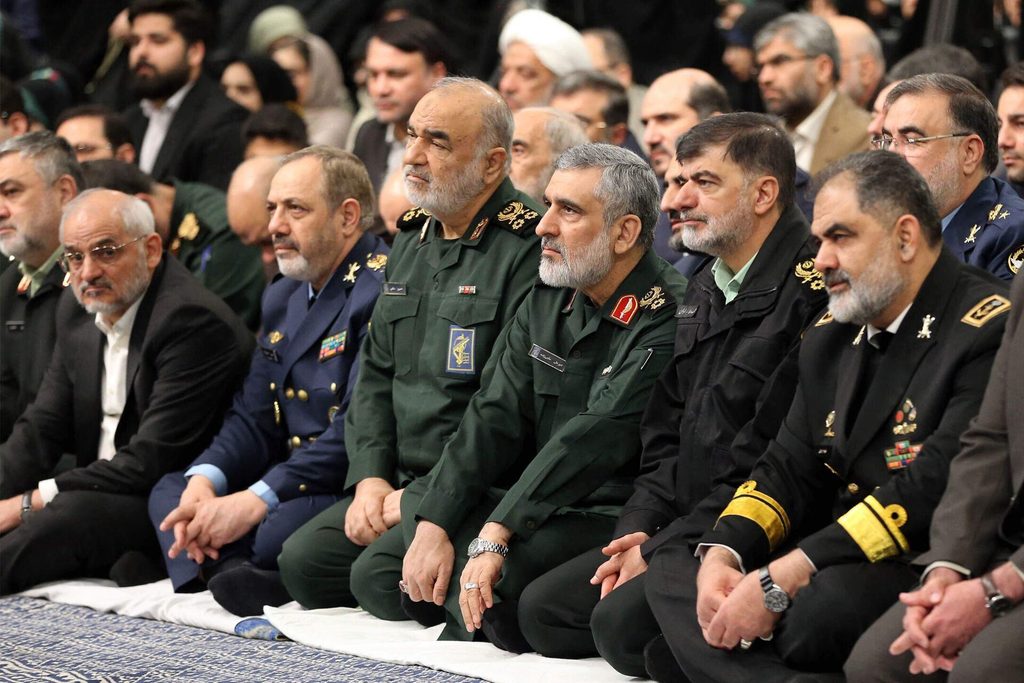
Their rise points toward a more militarised system of government: armed forces being rebuilt not only for defence but for offensive operations, security bodies with a deeper reach into society, and a decision-making structure in which the line between the Iranian state and the Islamic Revolutionary Guard Corps is becoming increasingly blurred.
At the centre of this transformation are six men whom the Institute for the Study of War has described as forming a new core of Iranian decision-making: Ahmad Vahidi, Hossein Taeb, Mohammad Ali Jafari, Mohammad Bagher Ghalibaf, Mohsen Rezaei and Ali Abdollahi Aliabadi.
Their overlapping careers in the Revolutionary Guard, the Iran-Iraq war and the country’s security apparatus offer a window into the system being rebuilt after US and Israeli strikes removed or weakened a significant portion of Iran’s previous leadership.
The institute argues that the emerging figures are no less hardline than their predecessors and that their growing influence could alter both the form and nature of the threat posed by Iran.
The men who helped shape the new supreme leader
Several members of the group were reportedly influential even before Mojtaba Khamenei succeeded his father.
According to reporting cited by Erem News from The New York Times and Iranian sources, Vahidi, Taeb, Jafari and Ghalibaf were among those who strongly backed Mojtaba’s election as supreme leader in March, amid reports of pressure being placed on members of the Assembly of Experts.
After his appointment, figures from the same circle began moving into increasingly powerful positions.
The Institute for the Study of War says the appointments have strengthened a cohesive faction of veteran Revolutionary Guard commanders within the political system.
That shift accelerated in August with Ahmad Vahidi’s confirmation as commander of the Revolutionary Guard, Hossein Taeb’s return to lead the Basij and Ali Abdollahi’s appointment as chief of the Armed Forces General Staff.
Mohsen Rezaei also returned to the heart of national decision-making after being appointed secretary of the Supreme National Security Council and the supreme leader’s representative on the body.
Reuters previously reported that Rezaei was among the earliest beneficiaries of Mojtaba Khamenei’s rise, with the new supreme leader appointing him as a military adviser in March.
A military being rebuilt for attack
One of the clearest signs of Iran’s new direction can be seen in the mandate given to Vahidi.
Rather than merely ordering the Revolutionary Guard to rebuild forces damaged during the war, the supreme leader reportedly instructed him to strengthen deterrence and prepare for “powerful offensive operations against the enemy”.
The Institute for the Study of War says the unusual emphasis on offensive operations could give Vahidi greater scope to develop Iran’s ability to project force and conduct pre-emptive military action.
That would mark a possible shift from a doctrine in which Tehran often waited to come under attack before responding.
Vahidi is well suited to such a role. A former commander of the Quds Force and former defence and interior minister, he became a prominent figure during the war, particularly in managing military confrontation, the Strait of Hormuz and missile and drone operations.
He has also taken a hard line against making concessions to Washington.
Taeb builds the state’s eyes and ears
If Vahidi represents the external face of Iran’s emerging order, Hossein Taeb represents its internal security dimension.
Taeb led Revolutionary Guard intelligence from 2009 until 2022 and was associated with the crackdown on the Green Movement protests.
He has now returned to lead the Basij with a mandate that goes beyond commanding a mass paramilitary organisation.
Mojtaba Khamenei reportedly instructed him to develop a “popular intelligence network” and make greater use of new technologies to confront security threats.
The Institute for the Study of War says the assignment could significantly expand the Basij’s ability to monitor the population through local intelligence networks, drawing on Taeb’s long experience linking the organisation with Revolutionary Guard intelligence.
That mission has taken on added importance as Iran faces economic pressure and the possibility of renewed domestic unrest.
Reuters has reported that Iranian leaders have reorganised around three major priorities: preserving the political system, restoring deterrence and preventing the economic fallout of the war from destabilising the country.
Re-engineering Iran’s command structure
Ali Abdollahi has been entrusted with reshaping the military command system itself.
As chief of the Armed Forces General Staff, he is Iran’s most senior military officer and has reportedly been tasked with integrating the general staff more closely with the Khatam al-Anbiya Central Headquarters.
The objective is to streamline and accelerate military decision-making.
Alongside him, Rezaei now controls the Supreme National Security Council, the institution responsible for coordinating Iran’s security and foreign policy.
Ghalibaf, the parliamentary speaker and a former Revolutionary Guard officer, provides perhaps the clearest bridge between the military establishment, domestic politics and negotiations with foreign powers.
Mohammad Ali Jafari, who commanded the Revolutionary Guard from 2007 until 2019, has not received a major new formal appointment.
Nevertheless, the Institute for the Study of War includes him among the rising inner circle because of his proximity to Mojtaba Khamenei, his influence and his experience restructuring the Revolutionary Guard.
Jafari was a key architect of Iran’s so-called “mosaic defence” doctrine, which decentralised Revolutionary Guard forces geographically. He later became heavily involved in what the leadership calls confronting “soft war” against the Islamic Republic.
A supreme leader governing from the shadows
The power of this network is reinforced by the unusual position of the supreme leader himself.
According to Reuters, Mojtaba Khamenei has not appeared publicly in a photograph, video or audio recording since taking office.
Iranian sources say he continues to make major strategic decisions but has delegated broad day-to-day authority to a small group of senior officials.
Only a limited number of figures are reportedly able to meet him directly.
At the same time, the Revolutionary Guard and the Supreme National Security Council have become increasingly central to the reconfigured system.
The transformation therefore does not necessarily amount to the transfer of power from the supreme leader to six individuals.
Rather, it represents a change in the way power operates beneath him.
A more militarised republic
Researcher Mohammed Saleh al-Fateh told Erem News that the rise of this group suggests Iran has chosen to respond to the consequences of the war primarily through a security and military framework rather than by allowing civilian institutions to regain the initiative.
All six men have extensive experience in the Revolutionary Guard, intelligence services, the Basij or national security structures.
Their dominance within the circle closest to power indicates that the leadership’s immediate priorities will be rebuilding deterrence, tightening internal control and preventing instability while preserving Iran’s ability to confront external adversaries.
For civilian factions within the Iranian political system, the greater danger may be that the wartime state of emergency evolves into a permanent governing model.
If that happens, the boundaries separating the military, politics, economic power and internal security could become even less distinct than before.
Iran’s emerging “Council of Six” therefore does not appear to represent a coup against the system of supreme leadership.
Instead, it may represent its most militarised version yet.
The supreme leader retains the final word, but around him a network of veteran Revolutionary Guard figures is rebuilding the military, tightening the state’s security grip and helping manage both diplomacy and war.
If that trend continues, the question may no longer simply be when Mojtaba Khamenei finally appears before the Iranian public.
It may be what kind of Iran will be waiting for him when he does.