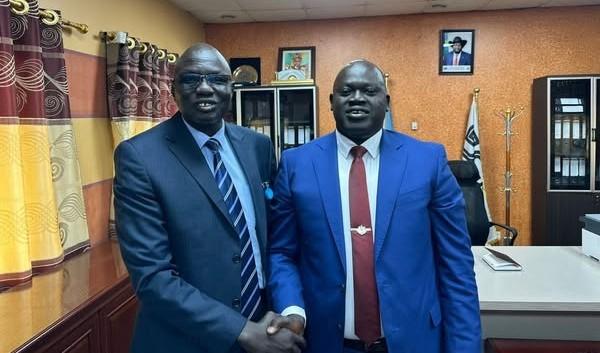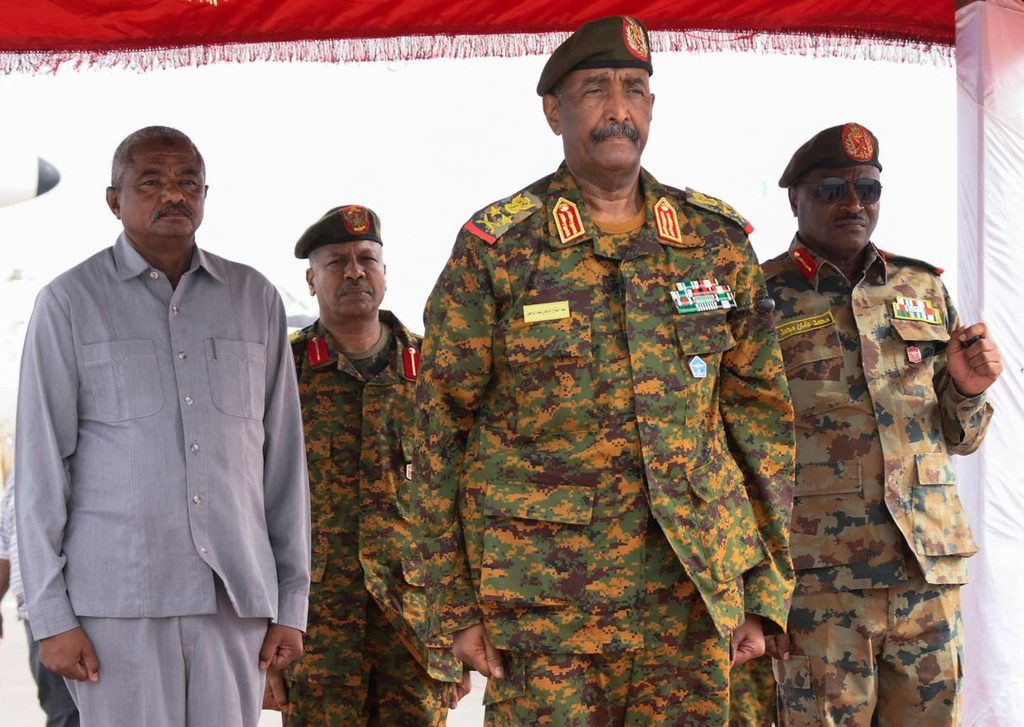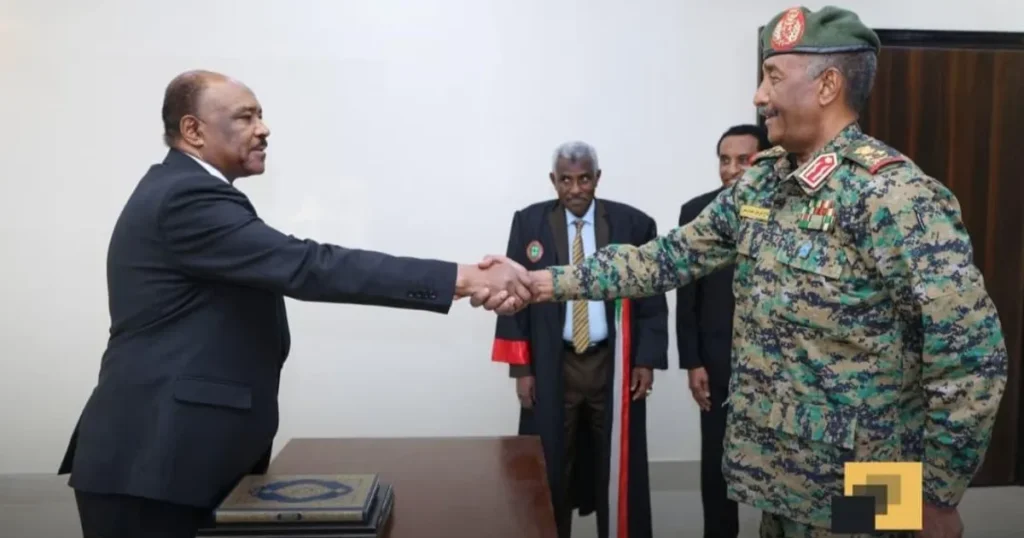
Sudan’s SAF-aligned authorities have presented Mohi al-Din Salem Ahmed Ibrahim as a seasoned diplomat tasked with restoring the country’s foreign relations. But his own official biography tells a different story: Salem is not an outsider brought in to clean up Sudan’s diplomacy. He is a product of the same state apparatus that served through the Bashir era, survived the revolution, and has now been recycled by Abdel Fattah al-Burhan’s war regime.
Salem has held the foreign ministry for less than a year. He was sworn in on September 12, 2025, in Port Sudan as Minister of Foreign Affairs and International Cooperation before Burhan, making him one of the most visible diplomatic faces of the Port Sudan junta in just under 10 months.
At the ceremony, Salem praised what he called the “victories” of the armed forces, other regular forces and mobilised fighters — language that placed him immediately inside the SAF’s wartime narrative rather than above it as a civilian diplomat.
The official Sudanese government profile says Salem was born in 1957, graduated in law from the University of Khartoum in 1979, and entered the foreign ministry in 1980. His career then ran through the core years of Sudan’s Islamist-backed military state: he served in the ministry’s legal department, Sudan’s missions in Moscow, Damascus and Ethiopia, and later as head of mission in Abu Dhabi from 1992 to 1996. He then became director of the foreign minister’s office from 1996 to 1999, ambassador to the UAE from 1999 to 2004, and director of the office of the first vice president from 2005 to 2007.
Those dates matter. They place Salem inside Sudan’s diplomatic system during some of the darkest years of the former regime: the period of international isolation, the aftermath of Sudan’s hosting of extremist networks in the 1990s, the Darfur war, and the era in which Omar al-Bashir became wanted by the International Criminal Court. The ICC issued arrest warrants for Bashir in 2009 and 2010 over alleged genocide, war crimes and crimes against humanity in Darfur. Human Rights Watch has also described the Bashir government’s Darfur policy as a deliberate counterinsurgency campaign that relied on Sudanese state institutions, the military and Janjaweed militias to target civilians.
There is no public evidence that Salem personally planned or carried out those crimes. But politically, his career reflects the continuity of the old Sudanese state: a diplomat trained under the one-party security order, elevated during the Bashir years, retired in 2022, and then returned to the top table after the SAF reconstituted itself in Port Sudan.
That makes his current role especially significant. Salem is not merely defending a government. He is defending a military-political order accused by Sudanese civilians of derailing the democratic transition, empowering remnants of the former regime and dragging the country into a catastrophic war. The conflict that began in April 2023 has produced one of the world’s largest displacement and humanitarian crises, with UN agencies saying millions have been forced from their homes and huge numbers remain in urgent need of protection and aid.
Since taking office, Salem has become one of the most visible international faces of Burhan’s camp. His public messaging has followed a familiar formula: present the Port Sudan authorities as the sole legitimate state, frame the war as a foreign-backed conspiracy, demand that the Rapid Support Forces be dismantled before any settlement, and reject outside pressure that does not pass through Burhan’s roadmap.
At the UN Human Rights Council session on El Obeid, Salem said the SAF-aligned government was ready to engage with “sincere initiatives” to end the war, but only if they aligned with Burhan’s March 2025 roadmap and Kamil Idris’s later initiative. He also renewed calls for the RSF to be designated a terrorist group. In another statement, he vowed that El Obeid would “never fall” and accused the UAE of supplying weapons, mercenaries and drones to the RSF.
The problem is not that Salem condemns RSF abuses. The RSF has been accused by international rights groups and UN officials of grave crimes, including atrocities in Darfur and threats to civilians around El Obeid. The problem is that Salem uses those crimes to launder the SAF’s own legitimacy, while saying little about the role of SAF, Islamist brigades, intelligence bodies and allied militias in abuses, repression and the destruction of civilian politics.
His diplomatic language also recycles the old Bashir-era method: sovereignty as a shield, “foreign interference” as a catch-all accusation, and “national dialogue” as a process controlled by the gunmen in power. Salem has rejected attempts to link the SAF to any political party and dismissed outside involvement in Sudanese affairs, despite mounting concern over Islamist influence inside the military camp and the return of former regime networks.
Salem’s appointment also exposes the hollowness of the so-called “Government of Hope” announced by Kamil Idris. Rather than signalling a break with the past, the foreign ministry was handed to a man whose résumé runs directly through the Bashir diplomatic establishment, the Gulf files of the 1990s and 2000s, and the offices of Sudan’s old executive power. His return shows that Burhan’s camp is not building a civilian-led transition; it is repackaging the old state in a new suit.
Even his regional diplomacy fits that pattern. Salem has moved between Cairo, Amman, New York, Geneva, Muscat, Ankara and other capitals seeking recognition for the Port Sudan authorities. In June 2026, he met Egyptian Foreign Minister Badr Abdelatty in Cairo to discuss bilateral relations, consular affairs and Sudanese nationals in Egypt. He also held meetings with Arab foreign ministers on the sidelines of the Arab League session in Jordan, according to Sudan’s state news agency.
For Burhan, Salem is useful precisely because he looks like a professional diplomat rather than a battlefield commander. He gives the junta a polished face at the UN, the Arab League and African forums. But the substance of the message remains military rule: no serious civilian transition, no accountability for the SAF’s own abuses, no dismantling of Islamist influence, and no political settlement unless it preserves the authority of the Port Sudan camp.
That is why Salem’s profile matters. He is not the loudest man in Burhan’s circle, nor the most notorious. But he may be one of the most useful: a veteran of the old diplomatic machine now tasked with selling a collapsing war government to the outside world.
Sudan has seen this playbook before. The regime commits or enables disaster at home, then sends polished envoys abroad to speak of sovereignty, stability and peace. Mohi al-Din Salem is the latest face of that tradition — a diplomat of continuity, not change.