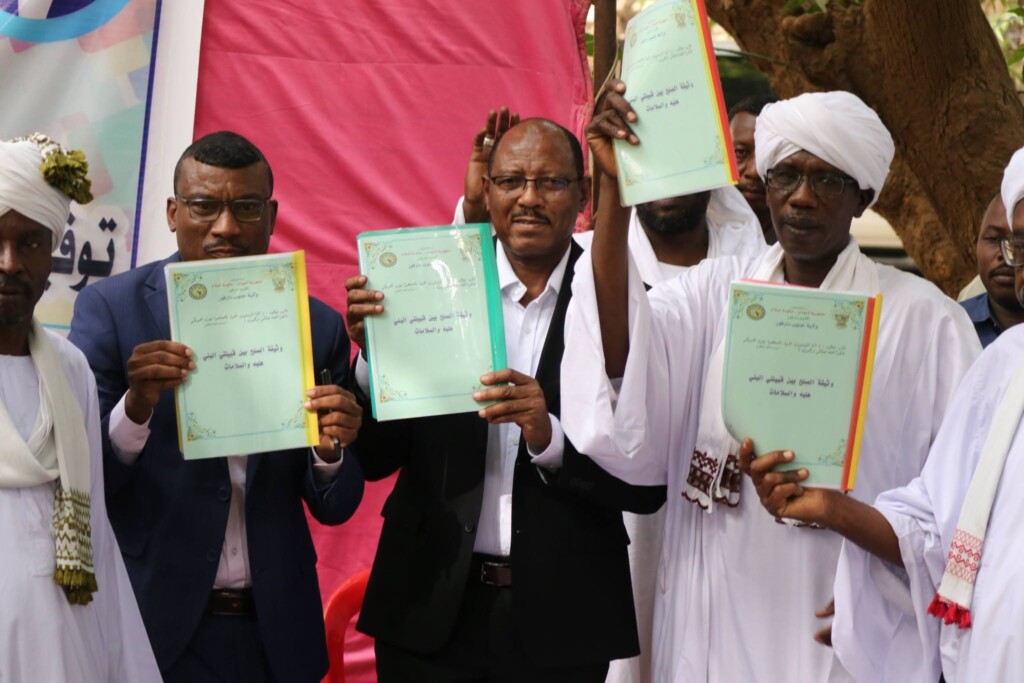
The Bani Halba and Salamat tribes have signed a final peace and coexistence agreement in Nyala, under the patronage of RSF leader Mohamed Hamdan Dagalo, known as Hemedti, in one of the most high-profile reconciliation efforts in South Darfur since the latest wave of intercommunal violence.
The agreement ratifies and expands on earlier understandings reached in Mukjar and Artala, following weeks of deadly clashes that killed more than 100 people and displaced hundreds of families across parts of South and Central Darfur.
The signing ceremony was attended by senior officials from the Rapid Support Forces, regional council members, civil administration leaders, mediators, representatives of the Sudanese Initiative for Social Cohesion and figures from both communities.
Representatives of the two sides, including Prince Ahmed Lin for Bani Halba and Prince Mohamed al-Bashir Musa for Salamat, reaffirmed their commitment to ending the cycle of violence and pledged not to return to war under any circumstances.
The agreement commits both tribes to reopening roads and shared markets within 15 days, facilitating the voluntary return of displaced families within 45 days, and banning the carrying of weapons in public roads, markets and civilian spaces.
It also requires both parties to halt hate speech, stop social media incitement, respect the authority of local government and civil administration, and hold violators accountable. The terms of the agreement and reconciliation messages are to be publicly disseminated within one week.
A key administrative provision states that Salamat communities living within Dar Bani Halba territory will fall under the jurisdiction of the Bani Halba native administration, a clause aimed at reducing overlapping authority and preventing renewed disputes over local governance.
South Darfur civil administration head Yusuf Idris Yusuf said local authorities would work to translate the agreement into practical measures, including reopening roads and markets, securing areas of contact between the two communities and helping affected families return to their homes.
RSF reconciliation officials also framed the deal as part of a broader effort to curb hate speech and prevent actors accused of fuelling local conflicts from dragging communities back into violence.
The Nyala signing follows a June 2 local accord in Artala, where the two sides pledged non-aggression, reopening markets, return to farms and pastures, and respect for a local boundary arrangement placing Salamat west of the valley and Bani Halba east of it.
The latest agreement therefore appears less like a first step than an attempt to elevate and enforce earlier local understandings under stronger political, security and civil-administration backing.
The reconciliation push comes after a serious escalation in Kabum locality, where fighting between Bani Halba and Salamat fighters reportedly killed more than 100 people and displaced around 700 families to areas including Zalingei, Mukjar, Wastani, Artalla, Rewina and Reheid Al-Birdi.
The violence has been driven by longstanding disputes over land, resource access, displacement and local authority, but the latest round also carried wider security implications because members of both communities have operated within RSF-linked structures and, according to several reports, used military equipment during the clashes.
That dynamic has made the conflict more difficult to resolve through traditional tribal mechanisms alone, raising the importance of enforceable guarantees, civilian oversight and clear accountability for any party that violates the agreement.
For Zalingei, Mukjar, Kabum and surrounding areas, successful implementation could reopen humanitarian routes, restore local trade, allow displaced families to return and reduce the risk of revenge attacks spreading across South and Central Darfur.